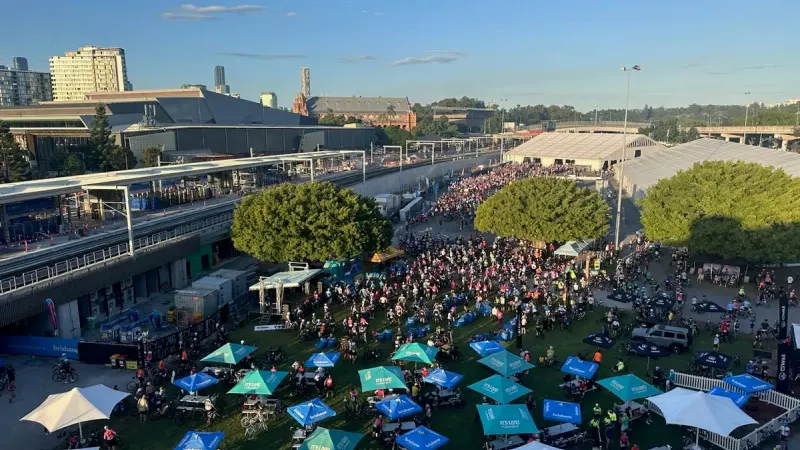
The places where crowd insight matters most are, with tedious reliability, the places where connectivity is worst. A festival paddock with forty thousand phones on one tower. A regional build with no site power until the switchboard goes in. A packed venue whose wifi gave up at gates open. If a platform only works when the network does, it will fail at exactly the moments it was bought for.
So we designed ours not to depend on it. This post covers the two halves of that: Off-Grid Communications, which keeps nodes talking to each other and to us, and remote-first delivery, which means almost nothing that keeps a site reporting has to happen at the site.
A mesh that heals itself
CrowdSense nodes form their own resilient LoRa mesh. Each node relays data to its neighbours, and the network routes automatically around obstacles, dropouts and individual node failures. If one node goes dark, the others find another path. Nobody has to notice, and nobody has to drive.
LoRa radios are long-range and low-power, which is what makes this work on a sprawling site over several days without anyone changing batteries. The mesh is sized for the site, not for the venue’s infrastructure, so standing up measurement on a greenfield site is a matter of hours rather than a procurement exercise for temporary internet.
Two further pieces make the mesh useful rather than merely clever. A local gateway aggregates everything on site, so you can view it live in the Companion App even with no internet connection at all. And store-and-forward buffering means every node holds its own data locally and syncs automatically when a connection returns, so a dropout never costs you a window of measurement. Where a site is genuinely remote, an optional cellular or satellite uplink pushes live data on to Aura OS.
Why it matters at peak
The honest case for the mesh is not the remote site. It is the busy one. Peak ingress, a gate surge, a capacity call: these are the minutes when the venue network is most loaded and when a gap in the data is least affordable. Mesh routing and buffering are there so the picture keeps updating through those moments, and so the Control Room reconciles the full record once the link is back rather than finding a hole where the surge was.
The same thinking runs through the rest of the platform. Nodes buffer locally through dropouts. Signage players cache their content and keep playing. Crew apps keep working over the mesh where there is no phone signal, and queue their actions to replay when the link returns.
Remote-first delivery
Connectivity solves the data problem. It does not, on its own, solve the distance problem: the regional client who wants to know what happens when something breaks four hundred kilometres from our depot. Our answer is that almost everything that keeps a site reporting happens on a bench in Banyo, over the air, or on a video call with the client’s own crew.
Every node is imaged, provisioned to its site, lens-fitted against the measured distance and run overnight on the bench at the real capture interval before it ships. It arrives asset-tagged, labelled with the site and the support number, already knowing where it belongs. A node is never configured for the first time at height.
Positions are designed from your drawings and a walk on a video call, with the field of view for each one mocked up against your own plan before anything is ordered. Commissioning is a call on the day: we compare the live frame against the agreed mock-up until they match, then watch the node run a full 24-hour cycle, darkness included, and verify the frames rather than the command that was accepted.
Changing, diagnosing and recovering from a desk
Once a site is live, the capture interval, the daily schedule, firmware, detection models and capture logic all move over the air, staged one node at a time with rollback if a release misbehaves. A pour week at a faster interval and a quiet month at a slower one are a setting, not a visit.
Every node reports its own health: power, signal, storage, last frame and last contact. You see the same status on your phone that we see on our desk, so a gap is spotted before it becomes a missing day.
When a node does fail, a sealed spare built to the identical standard has been sitting in your shed since install day. Your supervisor swaps it under our guidance, in about ten minutes, and the record resumes the same morning. The failed unit comes back to us and the spare is replaced. Where height work genuinely needs hands, we book a nominated local electrical or comms contractor, coordinated and paid by us, working to our position sheet and commissioning checklist.
Every month, before your claim goes in, we report on ourselves: frames captured against frames expected, with every gap explained and dated.
Where to read more
The mesh is described at /platform/off-grid-communications, and the full delivery model, including the seven-step sequence and the kit that lives in your shed, is at /platform/remote-delivery. If your site is a paddock, a basement or a long way from anywhere, talk to us about what that changes in the kit.